

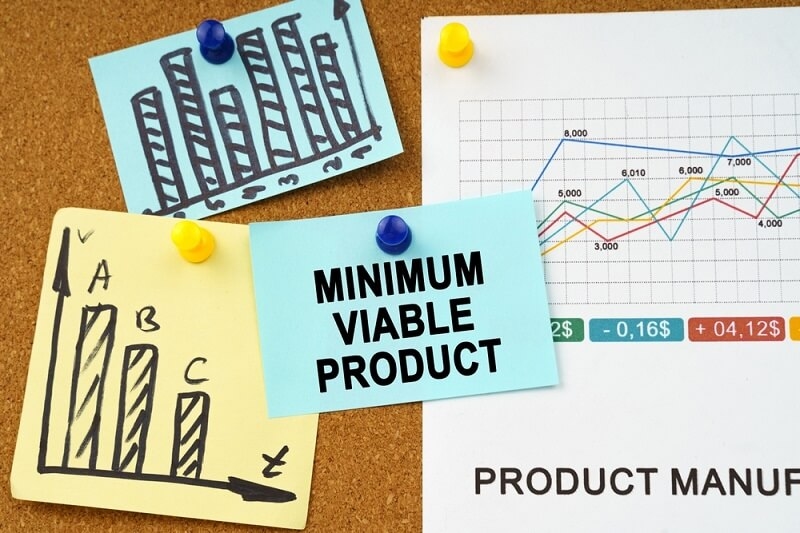
Today, the startup environment is highly competitive; thus, having a solid minimum viable product (MVP) strategy will either provide a pathway to scalable success or lead to significant cost overruns. By employing a step-by-step MVP Development Process Guide, a Quick Launch MVP Checklist, a Smart Product Iteration Strategy, and related tools, startup founders can validate their concepts with confidence. With the help of well-established principles (e.g., the MVP Testing Framework & build-measure-learn), this approach will lower risk, preserve cash, and align innovation with actual market needs.
If you're bootstrapping or trying to secure venture capital, understanding your MVP strategy helps you move forward strategically rather than just guessing where you're going.
Launching a product with a minimum viable product (MVP) strategy doesn’t mean releasing an incomplete product; rather, it means releasing the key features of your product to evaluate demand from real customers first. According to the U.S. Small Business Administration’s research, startups that validate their ideas first face much lower financial risk when scaling up.
Using a minimum viable product strategy allows you to:
The structured MVP development process provides continuity from concept through validation. Below is an outline of what that process looks like:
Get clear on one specific customer pain point you need to solve for, and don’t put too much emphasis on providing multiple solutions.
Create a prioritization matrix to highlight the essential features to launch in the MVP and remove duplicates from your product.
Only touch on what supports your core value proposition when developing your prototype.
Use data collection tools such as analytics, surveys, and customer feedback loops when testing your prototype. An effective MVP testing framework provides you with information on how effective the prototype is, rather than assuming it is successful.
The build-measure-learn (BML) method, developed by Eric Ries in The Lean Startup, emphasizes continuous learning through iterations. You quickly build a prototype, measure its performance, learn from the results, and continue making improvements until you have a complete product.
Taking these steps will help you reinforce your minimum viable product strategy while maximizing the efficiency of your resources.
Having speed is important, but having the right disciplines is even more important. The Launch MVP Quickly Checklist gives new ventures clear steps to ensure they can launch efficiently, while also to the greatest extent possible.
Using the Launch MVP Quickly Checklist gives you the confidence to pursue a Minimum Viable Product Strategy in an organized, measurable way.
Upon launch, the iterative process starts. A thorough approach to a startup's product iteration strategy is to use actual usage data to improve existing features.
The United States Securities and Exchange Commission reports that start-ups that document their performance measures and adapt their strategies are more likely to attract investors than those that do not. By executing a smart product iteration strategy, a start-up will also demonstrate flexibility and agility, as well as sound financial management.
The cycle is as follows:
A minimum viable product (MVP) strategy should always complement your business's long-term product iteration strategy (also referred to as development).
An MVP Testing Framework provides a structured approach to experimentation, enabling you to systematically collect feedback. When you don’t have this framework, feedback will be disorganized.
The three main components of an MVP Testing Framework are:
1. Quantitative Metrics – Measure churn rate, activation rate, and engagement rate.
2. Qualitative Feedback – Interview users and conduct usability tests.
3. Financial Monitoring – Use Federal Reserve economic best practice guidance for capital allocation discipline.
With a combination of quantitative and qualitative data, your minimum viable product strategy moves from being speculative to becoming data-driven.
The Build-Measure-Learn methodology will always be a cornerstone concept because it values experimentation over achieving a perfect product, and through using a practical minimum viable product (MVP) approach, founders will:
Each time you repeat the build-measure-learn loop, you will refine your process for developing an MVP and create an iterative product iteration strategy for your startup.
Efficient use of your capital is extremely important. Many founders spend funds before their product has been validated. Resources from the federal government (such as the U.S. Department of Commerce) show how critical it is to allocate resources strategically at that early stage of your company.
1) Include a budget forecast in your MVP Development guide.
2) Conduct a break-even analysis.
3) Plan for contingencies.
4) Build out a scalable technology infrastructure.
5) Have a strong MVP Strategy that ties product innovation to Financial IQ.
Founders often encounter expensive blunders when releasing their initial minimum viable product (MVP) through the use of a minimum viable product (MVP) checklist. Some examples of innovative products include:
By avoiding these mistakes, your MVP strategy will be lean, rational, and scalable.
The goal of creating a minimum viable product (MVP) is to develop an effective plan that helps startups establish themselves in the market and build a viable product. Achieving this requires a disciplined method for growing a business. Creating an efficient and successful MVP includes many aspects, such as having a clear process for developing the MVP; utilizing the tools needed to validate and test the quality of the MVP; applying a proven method to build, measure, and learn about your MVP; and implementing a defined methodology for iterating on your product with each iteration. Founders can significantly improve their business growth by reducing risk and increasing their ability to build a profitable, long-term business.
In addition, when used with a strong product iteration strategy, your MVP can evolve into a viable product that is capable of generating revenue. As the world becomes more focused on capital efficiency and delivery speed, your MVP will become your product's competitive advantage.
An MVP strategy is a product launch strategy that allows the entrepreneur to validate market demand, collect feedback, reduce risk, and improve subsequent product development by getting a minimum viable product into the market as quickly as possible.
The MVP Development Process Guide provides structure for planning, prioritizing, testing, and iterating throughout the development process. It helps new businesses avoid overspending, validate their market assumptions early in the process, and build only the features their customers will use.
The Build-Measure-Learn process is necessary for startups because it enables continuous experimentation. By developing small features, measuring each feature's success, and learning from each experiment's results, startups can develop their product development strategy in a timely and cost-effective manner.
The Launch MVP Quickly Checklist should contain at least the following items: problem validation, minimum viable features, integration of analytics into the product, clear identification of the target audience, and a method for collecting user feedback. Having each of these processes included in your list will help you to develop a large customer base quickly and efficiently.
This content was created by AI